
Lecture Note
Mastering Personal Productivity and the Psychology of Writing Things Down
-
University
John Jay College of Criminal Justice Course
PSY 200 | Cognitive PsychologyPages
4
Academic year
2026
-
David Neid
Views
601
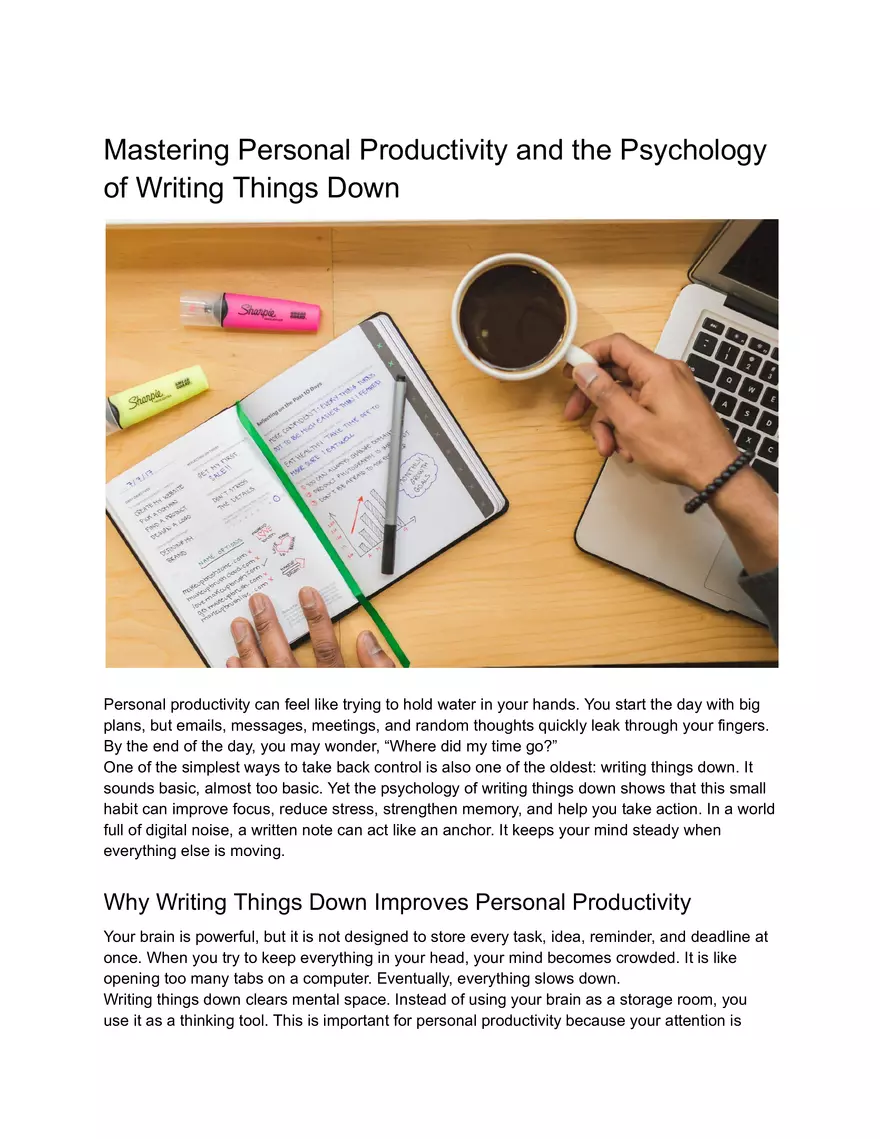
Mastering Personal Productivity and the Psychology of Writing Things Down Personal productivity can feel like trying to hold water in your hands. You start the day with big plans, but emails, messages, meetings, and random thoughts quickly leak through your fingers. By the end of the day, you may wonder, “Where did my time go?” One of the simplest ways to take back control is also one of the oldest: writing things down. It sounds basic, almost too basic. Yet the psychology of writing things down shows that this small habit can improve focus, reduce stress, strengthen memory, and help you take action. In a world full of digital noise, a written note can act like an anchor. It keeps your mind steady when everything else is moving. Why Writing Things Down Improves Personal Productivity Your brain is powerful, but it is not designed to store every task, idea, reminder, and deadline at once. When you try to keep everything in your head, your mind becomes crowded. It is like opening too many tabs on a computer. Eventually, everything slows down. Writing things down clears mental space. Instead of using your brain as a storage room, you use it as a thinking tool. This is important for personal productivity because your attention is
limited. The more energy you spend remembering small tasks, the less energy you have for solving problems, making decisions, and doing creative work. A written list also makes your responsibilities visible. A vague thought like “I have so much to do” becomes clearer when you write it down. Maybe you have seven tasks, not seventy. Once your work is on paper, it feels more manageable. You can plan, prioritize, and act instead of worrying in circles. This simple habit also creates a sense of commitment. When you write, “Finish report by 3 p.m.,” the task feels more real. It is no longer just a floating idea. It has shape, direction, and weight. The Psychology Behind Externalizing Your Thoughts Writing things down is a form of externalizing. That means you take thoughts from inside your mind and place them in the outside world. This matters because thoughts can feel messy when they stay in your head. On paper, they become easier to organize. Your mind loves clarity. When you write down a goal, task, or worry, you create distance between yourself and the thought. You are no longer trapped inside the mental storm. You are standing outside it, looking at the clouds. The brain likes closure Have you ever remembered an unfinished task at the worst possible moment? Maybe while trying to sleep? This happens because the brain keeps open loops active. Unfinished tasks demand attention because your mind wants closure. Writing things down helps close these loops. Even if the task is not completed yet, your brain relaxes because it knows the information is stored somewhere safe. A note, planner, or task list tells your mind, “You do not need to keep repeating this. It is handled.” Writing reduces decision fatigue Every day, you make hundreds of decisions. What should I do first? Should I answer this email now? Did I forget something important? These small choices drain mental energy. A written plan reduces decision fatigue. When your tasks are already listed and prioritized, you do not need to restart the planning process all day. You simply follow the path you created. Think of it like preparing a map before a trip. You may still face traffic, but at least you know the road. How Writing Things Down Helps You Focus Better Focus is not only about discipline. It is also about environment. If your workspace is noisy, your phone is buzzing, and your brain is full of reminders, staying focused becomes much harder. Writing things down gives your attention a target. Instead of thinking, “I should be productive,” you know exactly what to do next. Clear tasks reduce friction. And when there is less friction, action becomes easier.
For example, “Work on project” is too broad. It can feel heavy and unclear. But “Write the introduction for the project report” is specific. Your brain knows where to begin. That is why effective task management often depends on breaking large goals into smaller written steps. Writing also helps you protect deep work. Before starting an important task, write down distractions as they appear. Need to buy groceries? Write it down. Remembered a message to send? Write it down. Instead of leaving your main task, you capture the thought and return to work. This keeps your focus from being pulled in ten directions. A notebook can become a parking lot for distractions. The thought is not ignored; it is simply parked until later. Practical Ways to Build a Writing Habit for Productivity The best productivity system is not the most complicated one. It is the one you actually use. You do not need a perfect planner, expensive app, or color-coded life map. You need a simple method that fits your day. Start with a daily brain dump. Spend five minutes writing everything on your mind: tasks, ideas, worries, reminders, and goals. Do not judge or organize at first. Just empty the mental drawer. After that, choose the most important items and turn them into an action list. Next, use the “top three” rule. Each morning, write down the three most important tasks for the day. Not ten. Not twenty. Three. This helps you focus on progress instead of busyness. After all, being busy is not the same as being productive. A hamster runs all day on a wheel, but it does not travel anywhere. You can also write tomorrow’s plan before ending your workday. This creates a smoother start the next morning. Instead of sitting down and wondering what to do, you begin with direction. Another useful method is keeping a capture list. This is a place for quick notes throughout the day. It can be a small notebook, a notes app, or a single sheet of paper. The goal is to catch ideas before they disappear. Good ideas are like birds; they land for a moment, but they fly away if you do not catch them. Finally, review what you write. A list is only useful if you return to it. At the end of the day, check what you completed, move unfinished tasks, and notice patterns. Are you overplanning? Avoiding certain tasks? Forgetting breaks? Your notes become a mirror. They show how you work. Write It Down, Clear Your Mind, Take Action Mastering personal productivity does not always require a dramatic life change. Sometimes, it begins with a pen, a page, and a few honest minutes. Writing things down helps you clear mental clutter, reduce stress, improve focus, and turn vague intentions into visible actions. The psychology is simple but powerful: when your thoughts leave your head and land on paper, they become easier to understand and easier to manage. You stop carrying everything in your mind like a heavy backpack. Instead, you place it in front of you, sort it, and decide what matters most. So, the next time your day feels chaotic, do not try to think harder. Write it down. A written word can become a plan, a plan can become action, and action can become progress. Productivity is
not about doing everything. It is about knowing what matters and giving it your best attention, one written step at a time.
Comments
Mastering Personal Productivity and the Psychology of Writing Things Down

Recommended Documents


New Documents from this Uni


Please or to post comments