
Lecture Note
Building a Second Brain through Digital Minimalism
-
University
University of Houston Course
COMM 3388 | Digital Media EntrepreneurshipPages
4
Academic year
2026
-
Adrian Vance
Views
654
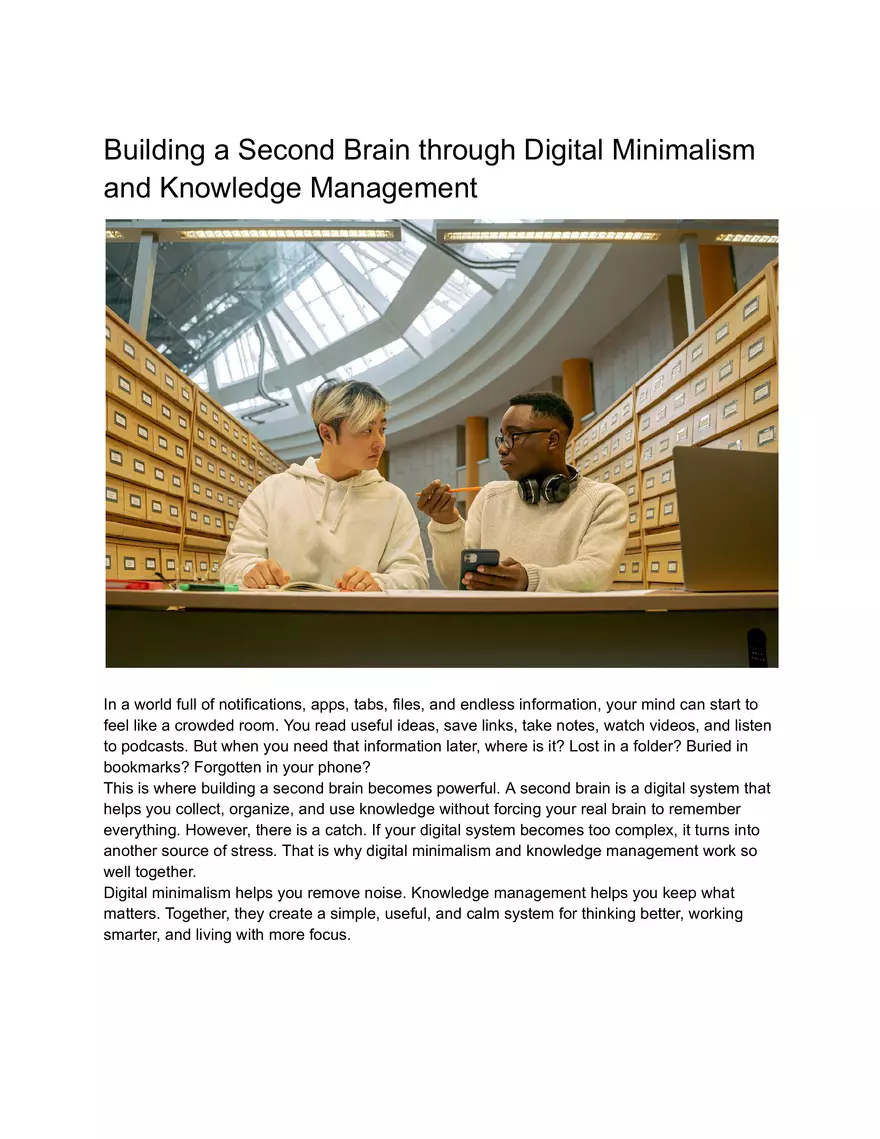
Building a Second Brain through Digital Minimalism and Knowledge Management In a world full of notifications, apps, tabs, files, and endless information, your mind can start to feel like a crowded room. You read useful ideas, save links, take notes, watch videos, and listen to podcasts. But when you need that information later, where is it? Lost in a folder? Buried in bookmarks? Forgotten in your phone? This is where building a second brain becomes powerful. A second brain is a digital system that helps you collect, organize, and use knowledge without forcing your real brain to remember everything. However, there is a catch. If your digital system becomes too complex, it turns into another source of stress. That is why digital minimalism and knowledge management work so well together. Digital minimalism helps you remove noise. Knowledge management helps you keep what matters. Together, they create a simple, useful, and calm system for thinking better, working smarter, and living with more focus.
What Is a Second Brain? A second brain is a trusted digital space where you store valuable information. It can include notes, ideas, quotes, project plans, research, personal reflections, and useful resources. Think of it like a clean desk inside your computer. Instead of leaving ideas scattered everywhere, you give them a home. The main goal is not to save everything. In fact, saving everything is one of the biggest mistakes people make. A second brain should help you act, create, decide, and remember. It is not a digital junk drawer. For example, imagine you are learning about personal finance. You might save key ideas from books, simple budgeting tips, useful articles, and your own thoughts. Later, when you want to make a financial plan, you do not need to start from zero. Your second brain gives you the building blocks. In simple words, your second brain turns information into usable knowledge. Why Digital Minimalism Matters Digital minimalism means using technology with clear purpose. It is not about deleting every app or living like it is 1995. It is about choosing tools that support your life instead of controlling it. Many people try to build a second brain by downloading many apps. One app for notes, one for tasks, one for bookmarks, one for articles, one for highlights, and another for habits. At first, this feels productive. But soon, it becomes a maze. You spend more time managing tools than using your knowledge. That is where minimalism helps. It asks a simple question: does this tool truly serve me? A minimalist second brain is easier to maintain. It has fewer places to check, fewer decisions to make, and fewer distractions. Like a small garden, it is easier to water, clean, and grow. When your system is simple, you are more likely to use it every day. Digital minimalism also protects your attention. And attention is the soil where deep thinking grows. Without attention, even the best notes become useless. How to Build a Simple Knowledge Management System A strong knowledge management system does not need to be fancy. It needs to be clear, repeatable, and useful. You can build it with tools like Notion, Obsidian, Evernote, Google Docs, Apple Notes, or even plain text files. The tool matters less than the method. Capture Only What Matters The first step is capture. This means saving ideas, notes, and resources before they disappear. But here is the golden rule: capture with intention. Do not save every interesting thing. Save what connects to your goals, projects, values, or curiosity. Ask yourself, “Will this help future me?” If the answer is no, let it go.
You can capture book notes, article summaries, meeting insights, content ideas, lessons from mistakes, or useful quotes. Keep it short when possible. A clear sentence you understand is better than a long copied paragraph you never read again. Organize for Action, Not Perfection The second step is organization. Many people get stuck here because they want the perfect folder system. But perfect systems often become heavy systems. Instead, organize your knowledge around action. What will you use this information for? You might create simple sections like Projects, Areas, Resources, and Archive. Projects are things you are actively working on. Areas are ongoing parts of life, such as health, career, learning, or money. Resources are useful materials you may need later. Archive is for inactive items. This structure keeps your second brain clean. More importantly, it helps you find knowledge when it is time to use it. After all, a library is only useful if you can find the book. Turning Information into Useful Knowledge Saving information is easy. Turning it into knowledge takes a little more effort. The difference is like buying ingredients versus cooking a meal. A folder full of notes is not wisdom. It is only raw material. To make your second brain valuable, you need to process what you capture. This does not have to be complicated. After saving something, add a quick note in your own words. Why is it useful? Where could you apply it? What does it remind you of? For example, instead of saving a quote about productivity and moving on, write one sentence: “This reminds me to plan my day before checking messages.” Now the idea is connected to your life. You can also link related notes. If one idea connects to another, create a connection. Over time, these links become a web of understanding. Your second brain starts to think with you, not just store things for you. Another useful habit is reviewing. Once a week, look through recent notes. Delete what no longer matters. Move useful notes into the right place. Highlight the best ideas. This small review keeps your system alive. Remember, knowledge management is not about collecting more. It is about creating more value from what you already have. Daily Habits for a Minimalist Second Brain The best second brain is the one you actually use. So, daily habits should be light and realistic. You do not need a two-hour routine. You need a few small actions that fit into normal life. Start with a simple inbox. This is one place where new ideas land. During the day, capture quickly. Do not organize everything immediately. At the end of the day or week, clean the inbox.
Next, write short notes in your own voice. Your second brain should sound like you, not like a textbook. Use simple language. Add examples. Make ideas easy for your future self to understand. Also, connect notes to real projects. If you are writing an article, planning a business, studying a topic, or improving your health, attach useful information to that goal. Knowledge becomes more powerful when it has a job. Finally, remove regularly. Digital minimalism is not a one-time cleaning event. It is a habit. Delete old screenshots, unused bookmarks, random files, and notes that no longer serve you. A lighter system creates a lighter mind. Building a second brain through digital minimalism and knowledge management is not about becoming a productivity machine. It is about creating space to think, learn, and act with clarity. Your mind was not designed to hold every link, task, idea, and reminder. Let your digital system carry the weight, but keep it simple enough to trust. When you capture only what matters, organize for action, and review with care, your second brain becomes more than a storage tool. It becomes a quiet partner in your growth. In the end, the goal is not more information. The goal is a better life with less noise and more meaning.
Comments
Related Documents
Building a Second Brain through Digital Minimalism


Please or to post comments